
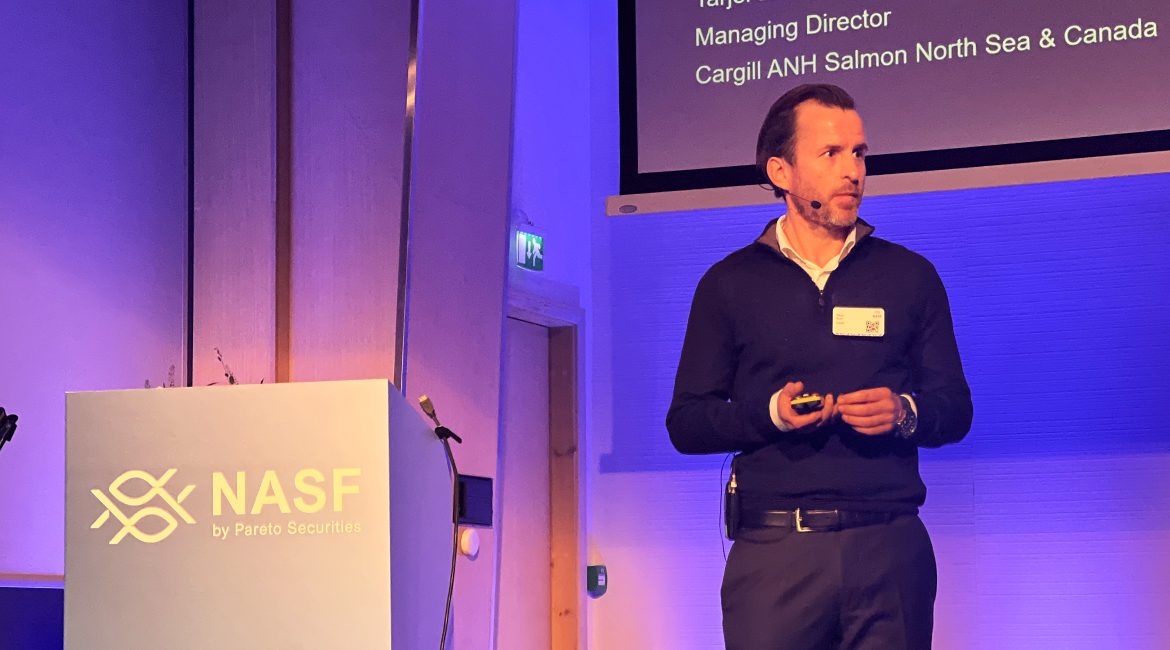
At this year’s North Atlantic Seafood Forum (NASF), Cargill’s Aquafeed business for the North Sea & Canada demonstrated how feed has become a defining strategic lever in modern aquaculture, influencing farm performance, fish welfare, sustainability and long-term industry growth.
With one in three salmon globally eating feed from Cargill Global Salmon, the responsibility — and opportunity — to drive performance and sustainability at scale is significant.
“Discussing the strategic direction of our industry requires a holistic understanding of the entire value chain, from raw materials and increasing access to biological and operational data, to how value is created through integrated solutions that includes platform, people and products at every stage,” said Tarjei Eide, Managing Director, Cargill Salmon North Sea & Canada, who hosted the Aquafeed Summit session.
A Value Chain Perspective on Growth
The Aquafeed Summit brought together leading voices from across the seafood value chain to explore how aquaculture can unlock future growth.
Sverre Martinsen, Partner at Boston Consulting Group (BCG), opened the session by outlining the global growth potential for salmon. He highlighted how strengthening competitiveness requires viewing aquaculture from a consumer perspective and positioning salmon as a leading sustainable protein source.
Raw material availability and innovation formed another key theme. Charles Hart, Senior Commodity Analyst at Rabobank, provided insights into marine and plant-based ingredient markets, emphasizing that future growth depends on continued development, diversification and innovation in feed raw materials.
Scenario Planner Progress
Lise Andreasen, Commercial Director, Cargill Salmon North Sea & Canada, addressed the often-overlooked complexities of feed production. She also demonstrated how integrated feed solutions and smarter feed management systems can adapt diets to site-specific farming conditions — unlocking additional biological and economic value for customers.
José Ramón Gutiérrez, Chief Financial Officer at Multi X, shared how the Chilean salmon producer navigates local operational challenges. He highlighted the importance of reshaping the farmer–feed supplier relationship into a stronger partnership model to drive performance and long-term value creation.
Petter Eilertsen, partner in Egon Zehnder, a global leadership advisory firm specializing in executive search, board advisory and leadership development, outlined strategic leadership imperatives and concrete ways to accelerate leadership capacity in aquaculture to meet future challenges.
The session concluded with a panel discussion led by Eide, featuring Audun Sivertsen Fjeldvær, CEO of ScaleAQ; Trond Håkon Schaug-Pettersen, CEO of Salmon Evolution; and Runar Sivertsen, Chief Strategy Officer at SalMar. The panel explored how technology, data and innovation can unlock growth, accelerate sustainability improvements and operational efficiency across the industry.
Poultry Meal: A Practical Climate Lever
The day before the Aquafeed Summit, Eide also spoke at the Aqua Industry News session, where he highlighted poultry meal as one of the most impactful measures currently available to reduce the carbon footprint of salmon feed.
Describing poultry meal as a “re-innovation” in the Norwegian market, Eide emphasized that it is a mature, well-regulated ingredient backed by nearly two decades of research and more than 300 feeding trials. When properly balanced within the diet, poultry meal delivers strong performance while maintaining fish health and welfare.
Importantly, depending on inclusion levels, poultry meal has the potential to reduce feed-related emissions by up to 10 percent — making it one of the most significant single levers available to improve feed sustainability at scale.
About NASF
The North Atlantic Seafood Forum (NASF) is the world’s largest and most influential executive seafood business conference. Held annually in Bergen, Norway, NASF gathers more than 1,000 senior leaders, CEOs, investors and industry experts from across the global seafood value chain to discuss market developments, sustainability, innovation and future growth.
In addition to being the most important event on the North Sea & Canada aquafeed business calendar, this even also attracted colleagues from the Chilean aquafeed business as well as R&D and protein people from the US.